Maybe your central air stopped cooling in August and you got through the rest of the summer with fans. Maybe it ran but left the upstairs warm, or it kept tripping the breaker. Now it is November in Orillia and the question is still open: fix it or replace it.
You have time to think it through. By mid-November the normal overnight low in Orillia is below freezing, so nobody needs cooling for months. That gives you a chance to look at your options before the next hot spell.
What is safe to check before anyone comes out?
A few things are safe for a homeowner to look at:
- The furnace filter. Central air uses the furnace blower, and a clogged filter cuts airflow and can freeze the indoor coil.
- The thermostat. Check that it is set to cool and that the batteries are fresh.
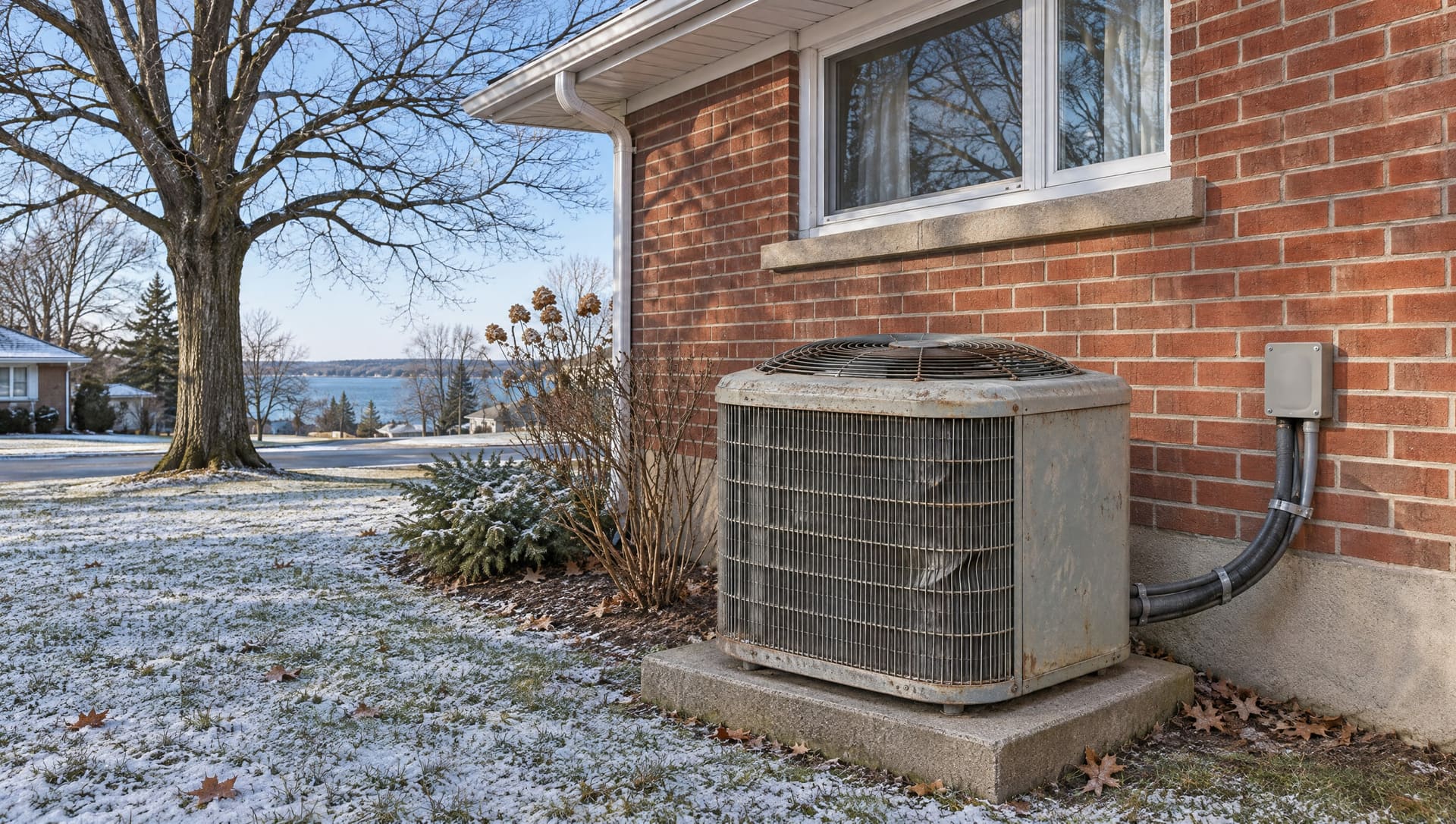
- The outdoor unit. Look for leaves, cottonwood fluff or grass clippings packed into the fins. In winter, keep snow and ice from burying it.
- The breaker. If it tripped once, you can reset it once.
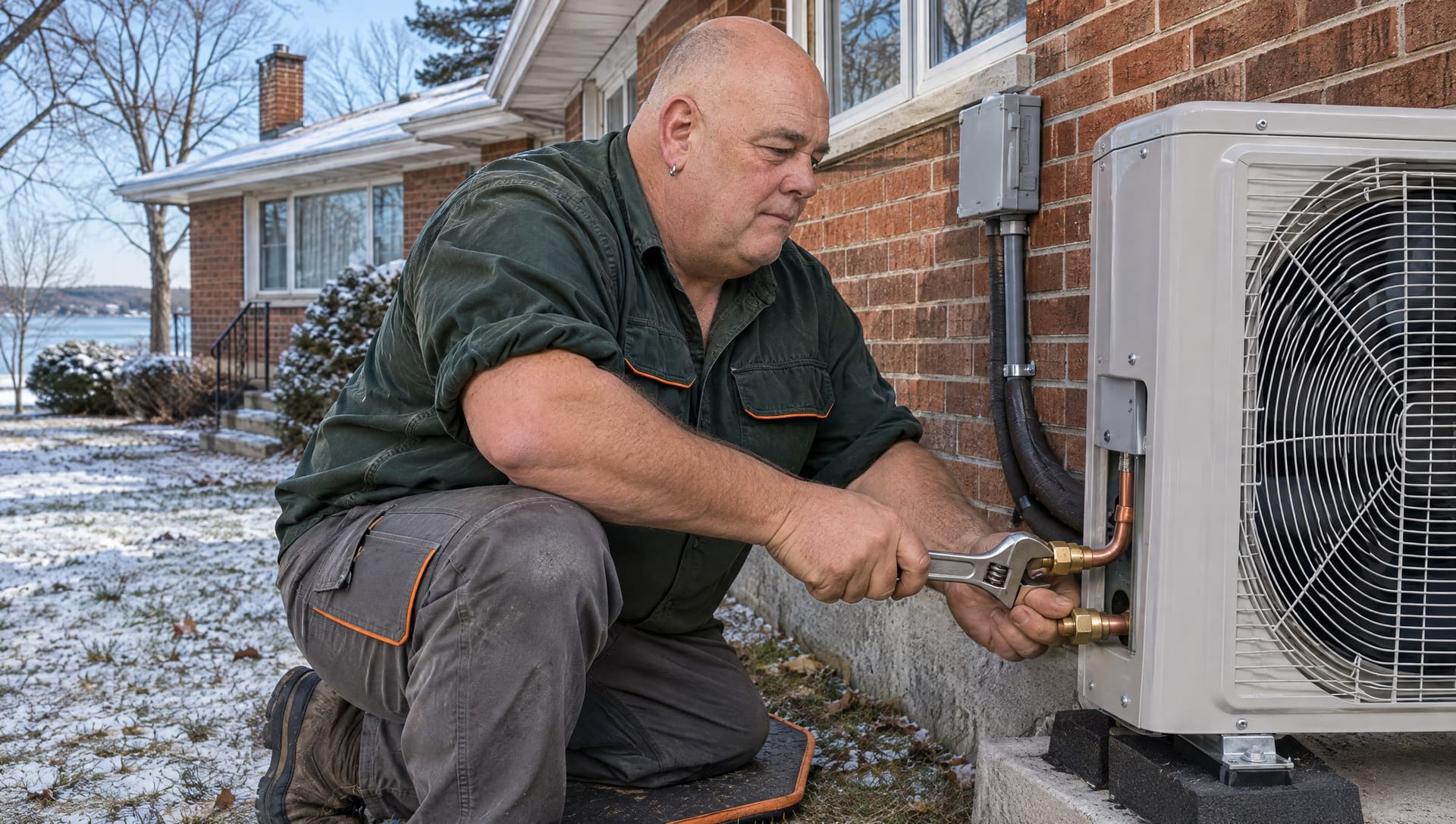
Do not keep resetting a breaker that trips again. That usually points to an electrical fault in the compressor, fan motor or wiring, and it needs a technician. Leave the refrigerant lines and the electrical panel inside the outdoor unit alone as well. Refrigeration work in Ontario is a compulsory trade. Work is performed by 313A refrigeration and air conditioning mechanics.
Is it worth it to repair an air conditioner?
Often, yes. A lot of failures are small parts:
- A failed capacitor, which helps the compressor and fan motor start
- A worn contactor, the switch that turns the outdoor unit on
- A blocked condensate drain, which causes water around the furnace
- A dirty or frozen indoor coil caused by poor airflow
When a system is in reasonable shape and the fault is one of these, repairing it is usually the sensible choice.
The answer changes with bigger faults. These are the ones that send people toward replacement:
- A failed compressor. It is the main component of the outdoor unit, and on an older system replacing it costs a large share of what a new unit would.
- A refrigerant leak in the coil. A leak can sometimes be found and repaired. When the coil itself is corroded, topping up the refrigerant only buys time.
- Older refrigerant. Some older systems use a refrigerant that is no longer produced. It gets harder to find and more costly to recharge every year.
A simple way to weigh it: think about the age of the system, the size of the repair compared with a replacement, and whether this is the first failure or the third. A young system with one failure is worth fixing. An old system that needs a major part, after a few other repairs, usually is not. A good technician will give you both prices and let you decide.
What does an air conditioner repair usually cost?
There isn't really an average worth quoting, because the range is so wide. These are the things that set the price:
- The part. A capacitor or contactor costs very little next to a compressor or a coil.
- Refrigerant. Finding a leak, repairing it and recharging the system adds labour and material.
- Access. An outdoor unit tucked behind a deck, or an indoor coil boxed into a finished basement, takes longer to reach.
- Timing. Parts for some older units take longer to source.
What you need is the price for your system. Ask for the diagnosis and the repair price in writing before any part goes in. If the price is a large share of a replacement, ask for the replacement price as well so you can compare them.
How does the age of your house change the answer?
The house often matters as much as the air conditioner. Orillia has a lot of older housing. Of the 14,425 occupied homes counted in the 2021 Census, 4,510 were built in 1960 or before and another 3,855 between 1961 and 1980. That is more than half the city.
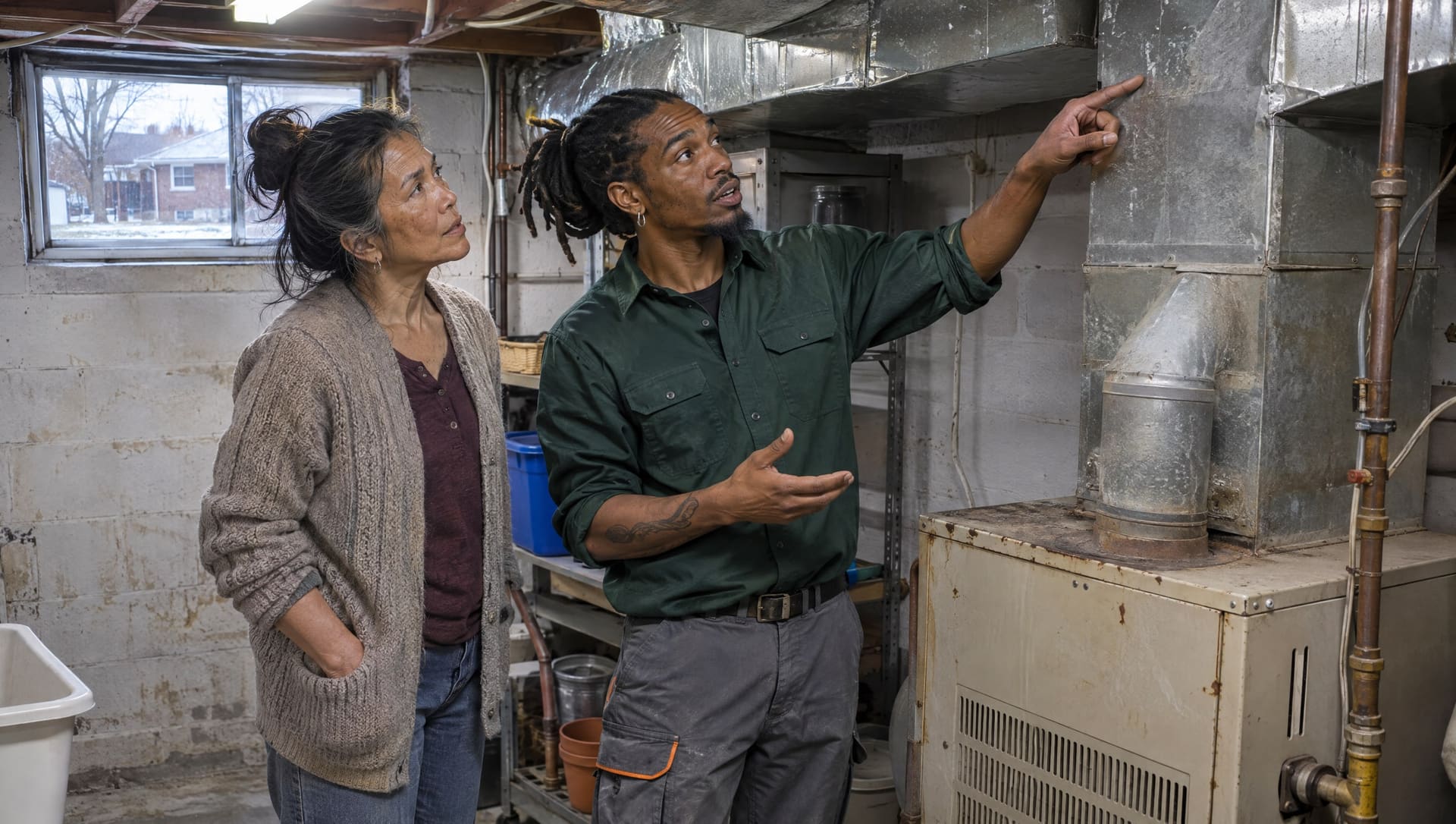
**The oldest homes.** Houses on Mary Street, Mississaga Street West and Laclie Street were built for stoves and coal. Many were later given hot-water radiators and no ductwork at all, or ducts that were added afterward and are too small. If you have one of these, a failing window unit or an old add-on system often points toward a ductless system rather than another central unit. See air conditioning installation.
**Wartime and post-war homes.** Around Westmount Drive and on Argyle and Albany streets, the ducts tend to be small and sparse, with weak airflow to the upper half-storey. A new, larger air conditioner will not fix a cool main floor and a warm bedroom upstairs. Sometimes the better spend is on the ductwork, or on a ductless head for the upper floor.
**Newer homes.** West Ridge and West Orillia homes, built from 1998 onward, were ducted for central air from the start. The builder-installed equipment in many of them is now reaching the end of its service life. In these homes the choice is simply repair or replace, and the ducts can usually take a modern system.
Is it cheaper to replace the AC and furnace together?
Often it costs less overall than doing them separately, though it is not automatically the right choice.
The air conditioner's indoor coil sits on top of the furnace, and both use the same blower. Replacing them together means:
- One installation visit instead of two, with shared labour
- A matched coil and blower, which helps the system reach its rated efficiency
- No new air conditioner tied to an old furnace blower that limits it
If your furnace is fairly young and working well, there is no reason to replace it just because the air conditioner failed. If both are close in age and the furnace is already showing its years, doing them together is worth pricing. The furnace should be sized to the house and its ducts, not to the old label. Our furnace sizing guide explains why.
Also consider a heat pump in place of a new air conditioner. It cools in summer the way an air conditioner does, and it heats as well. Cold-climate models and hybrid systems, where the gas furnace takes over on the coldest nights, are both options in Orillia, where Enbridge Gas supplies natural gas. See heat pumps.
Are there rebates for a replacement?
There may be. The City of Orillia points homeowners to Save on Energy, Enbridge and Natural Resources Canada's directory of energy efficiency programs to find what is currently offered. Programs change, and some need an assessment or approval before the work is done, so check before you commit. Our rebate guide walks through where to look.
What is the quietest type of air conditioner?
If noise is part of the reason you are replacing, these make a real difference:
- Variable-speed (inverter) systems. They run at low speed most of the time instead of switching hard on and off, so they are quieter and steadier.
- Ductless systems. The compressor is outside. The indoor head usually makes little more than a soft hum, which suits bedrooms in older homes.
- Placement. Where the outdoor unit sits matters as much as the model. Keep it away from bedroom windows, off hard walls that bounce sound, and on a level, solid base.
- Airflow. A lot of the noise people blame on an air conditioner comes from undersized ducts or returns. Fixing the airflow can quiet an existing system.
Manufacturers publish sound ratings for their units. When you compare quotes, ask for them and compare like with like.
What should you do next?
Write down what the system did and roughly how old it is, if you know. Have it diagnosed, ask for the repair price in writing, and if the repair is a large one, ask for a replacement price too. Then decide over the winter.
If your central air has a fault you would like diagnosed before next summer, see air conditioner repair.