If you are replacing a furnace, you have probably looked at the label on the old one and assumed the new one should match. That is a reasonable first guess. It is also often wrong, and it is worth a few minutes to understand why before you approve a quote.
The short version: the right size depends on how much heat your house loses on a cold night and how much air your ducts can move. Neither of those is printed on the old furnace.
Why isn't the old label the answer?
The furnace in your basement may have been sized decades ago, for a house that has changed since. Windows get replaced, attics get more insulation, basements get finished, and drafty houses get sealed up. Each of those changes lowers the heat the house needs.
Older furnaces were also often oversized on purpose, as a safety margin, and some were simply matched to whatever the previous furnace said. So the label can carry forward a guess made two or three furnaces ago.
Efficiency makes a difference too. An old furnace's rating shows how much gas it burns, not how much heat reaches your rooms. A modern high-efficiency furnace delivers more of its fuel as heat, so a straight label-for-label swap tends to land on a unit that is bigger than needed.
What size furnace do I need for a 2,000-square-foot house?
There is no single answer, and a contractor who gives you one from square footage alone is guessing. Two houses of the same floor area can need very different furnaces.
What changes the number:
- How well the walls, attic and basement are insulated
- The age, size and number of windows
- How much air leaks in around doors, sills and old chimneys
- Whether the house is a compact two-storey or a long bungalow with more outside wall
- How the house faces the wind and sun
- Whether the basement is heated living space
The proper method is a room-by-room heat loss calculation. A technician measures the house, notes the insulation and windows, and works out how much heat it loses on a design cold day. The furnace is chosen to meet that with a sensible margin, not a large one.
Orillia's winters make this matter. Environment Canada's normals for mid-November show a maximum of 5°C and a minimum of -3°C, so overnight lows are normally below freezing well before the deep cold of January. The furnace has to carry the house through the coldest stretch, but it spends most of the season running well below full output.
What goes wrong when a furnace is too big or too small?
An oversized furnace heats the house in short bursts. It turns on, overshoots, shuts off, and repeats. That short cycling leaves rooms uneven, makes the system louder, and wears parts faster because most of the wear happens on start-up. It can also push more air than the ducts were built for, which you hear as whistling registers and rushing air.
An undersized furnace runs for long stretches and may not keep up on the coldest nights. This is less common, but it does happen when someone downsizes on square footage alone.
A correctly sized furnace runs longer, steadier cycles. The house feels more even, and the equipment tends to last.
Why do the ducts matter as much as the furnace?
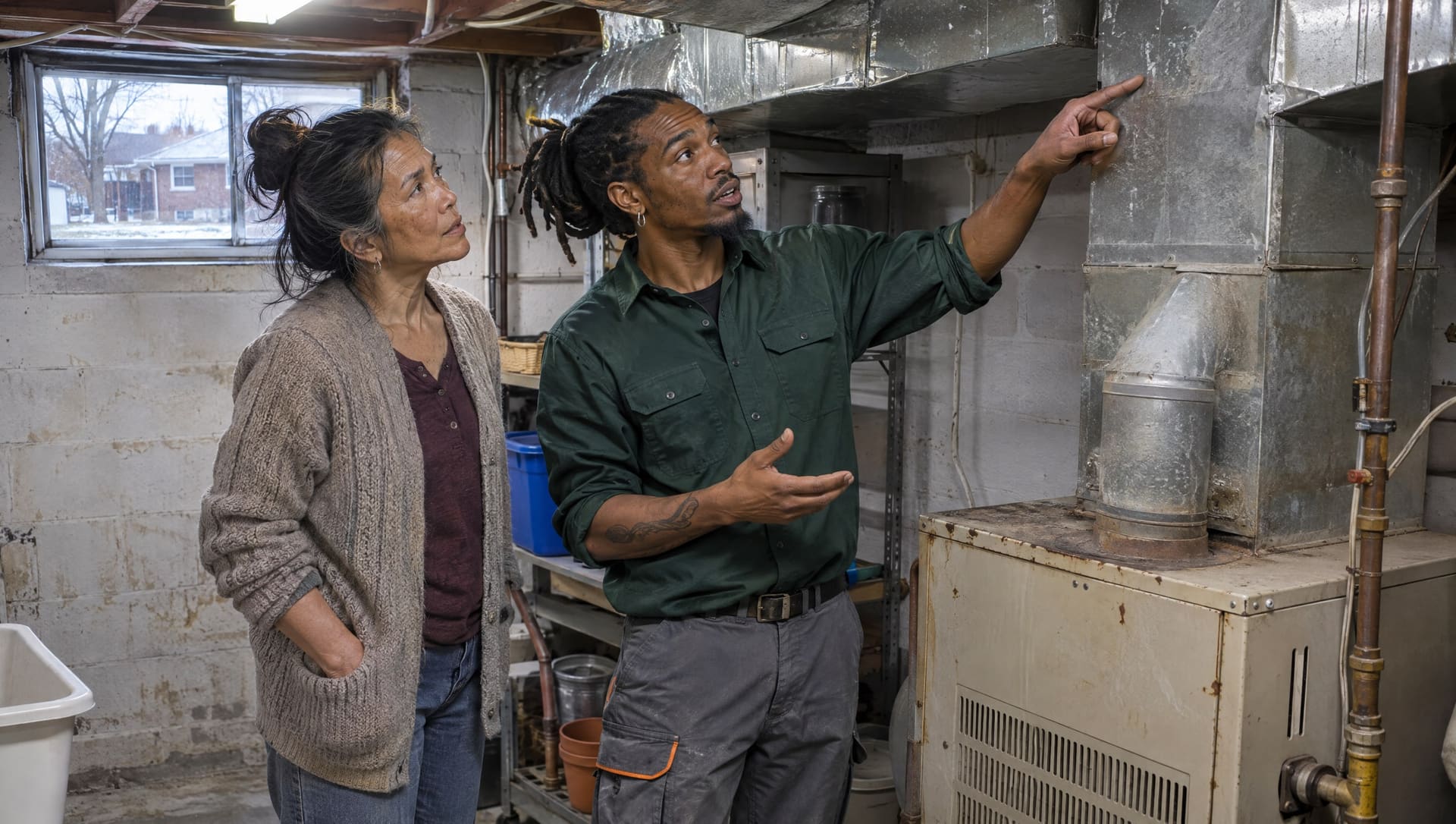
A furnace can only deliver heat through the ducts it is connected to. If the ducts are small or the return air is limited, a bigger furnace does not help. It just runs hotter and louder.
This is where the age of your Orillia house comes in. According to the 2021 Census, of the 14,425 occupied private dwellings in the city, 4,510 were built in 1960 or before and another 3,855 between 1961 and 1980. That is a large share of older housing, and older housing usually means older ductwork.
What technicians tend to find, by era:
- The oldest homes, from around 1875 onward. Houses like the Queen Anne homes on Mary Street and Mississaga Street West were built for stoves and coal, then given hot-water boilers with radiators or ducts added later. Duct runs are often undersized, and some houses have no ductwork at all on certain floors. An old masonry chimney usually needs a liner before a modern furnace can go in.
- Wartime to mid-1950s homes. Around Westmount Drive, and on Argyle and Albany streets, houses usually started with a gravity or early forced-air furnace on coal or oil, later converted to gas. Ductwork is often small and sparse, and the upper half-storey gets weak airflow. The chimney may need a liner when the furnace is replaced, and sometimes an old oil tank is still in the basement.
- West Ridge and West Orillia, 1998 onward. These homes were built with forced-air gas furnaces and ducting for central air. The newer ones have high-efficiency furnaces vented through plastic pipe out the side wall. Here the usual question is whether the original builder-installed equipment is reaching the end of its life, rather than the ductwork.
In the older homes, a duct assessment is part of sizing. Sometimes adding a return or opening up a restricted run does more for comfort than any change in furnace size.
What about the chimney and venting?
A high-efficiency furnace vents through the side wall with plastic pipe, not up the chimney. When the old furnace leaves the chimney, a gas water heater may be left venting alone into a flue that is now too large for it. That can stop it from drafting properly, which means combustion gases may not leave the house as they should. A chimney liner sized for the water heater is the usual fix, and it should be part of the quote.
Side-wall vents need a clear path. Where snow drifts against the house, the vent location and height matter, because a buried intake or exhaust will make the furnace shut itself off.
Carbon monoxide is the one real danger with any gas appliance. The Ontario Fire Code requires a working carbon monoxide alarm next to each sleeping area of a home with a fuel-burning appliance, a fireplace or an attached garage. Check yours when the furnace changes.
What kind of furnace do most Ontario homes have?
In Orillia, natural gas comes from Enbridge Gas, and houses with ductwork are most often heated by a forced-air gas furnace. Newer homes, and most replacements, use high-efficiency condensing furnaces with side-wall venting. Older homes may still have a boiler and radiators, or a converted furnace on retrofitted ducts.
North of the city, Washago and the surrounding parts of Severn Township have been beyond the gas main. The Ontario Energy Board has approved an Enbridge project to bring natural gas to about 473 homes and businesses there, with service planned to start in the 2027/2028 heating season. Until then, many of those homes heat with propane or oil, and the furnace and venting differ with the fuel.
Some homeowners also look at a cold-climate heat pump, alone or paired with a gas furnace as a hybrid system. If you are replacing a furnace anyway, it is worth asking about. See heat pumps, and our guide to heating and cooling rebates in Ontario for where to find current programs from Save on Energy, Enbridge and Natural Resources Canada.
Can you install your own furnace?
No, not a gas or propane furnace in Ontario. Under Ontario Regulation 212/01, gas appliances must be installed, serviced and repaired by a registered contractor using gas technicians who hold a G1, G2 or G3 qualification. The installation itself must follow the CSA B149.1 Natural Gas and Propane Installation Code, which covers gas piping, venting, clearances and combustion air.
This also protects your warranty. A proper installation keeps the manufacturer's warranty valid, and most manufacturers require professional installation and registration for their warranty terms to apply. Read those terms before you sign.
There is still useful work you can do yourself: find out your house's insulation and window history, note which rooms run cold, change the filter, and keep side-wall vents clear of snow.
At Orillia Heating, work is performed by TSSA-certified gas technicians.
What should a good quote include?
When you compare quotes, look for:
- A heat loss calculation, not a number based on the old label or square footage
- A note on the ductwork and return air, especially in older homes
- The venting plan, and whether the chimney needs a liner for the water heater
- Removal of the old unit, and of any abandoned oil tank if there is one
- The manufacturer's warranty terms and registration steps
- A written price you approve before work starts
If a quote skips the sizing step, ask how the size was chosen. A clear answer is a good sign.
When you are ready to have your house measured and the size worked out properly, see furnace installation and replacement.